

The BSCF is a Community Interest Company that provides independence and impartiality when assessing and validating the competence of building control professionals.
The building control validation assessment has been developed to enable experienced building control practitioners to demonstrate their competence in relation to building regulations. It is with this in mind that the Building Control Professional (BCP) Competence Validation Assessment will focus on the majority of work that the many BCP’s are likely to be involved in. However, the competencies being assessed will include an understanding of the limits of a surveyors own competence and when they should seek advice, learning and additional support.
THE MEASURE OF COMPETENCE
Whilst many have years of experience as Building Control Surveyors there has never been a true demonstrable measure of the competence of a building control surveyor. By April 2024 all levels of building control surveyor will need to have their competence validated in order to register with the Building Safety Regulator as a Registered Building Inspector (RBI).
The BSCF has created an assessment to allow experienced surveyors to validate their competence.
SCOPE(S) OF CERTIFICATION
The scope of certification confirms the building types and limits for which a Building Inspector has been assessed and certificated.
Certification scope should be read together with any applicable limitations, supervision requirements and scheme rules.
| Category | Certification title | Former BSCF Band |
Scope Description |
| Category 2A | Domestic Building Inspector |
Band A |
Dwelling house1 (excluding flats) of traditional2 construction and not having more than one basement storey. |
| Category 2ABD |
Medium Rise Residential / Commercial Building Inspector |
N/A | Premises3 of either traditional construction or open/closed panel timber frame construction, where Approved Document guidance can be applied, including, where appropriate, references to other standards & guidance and being within the size limits mentioned in the table below. |
| Category 2A-F | General Practice Building Inspector | Band B | Premises3 of any type and form of construction, where the guidance contained in the Approved Documents can be applied, including, where appropriate, references to other standards & guidance and being within the size limits mentioned in the table below. |
| Category 3GH | Specialist Building Inspector | Band C |
Premises3 of any type, height, size, form of construction and method of design, including any premises that will be within the scope of the Building Safety Regulator. |
| Building Type | Category 2A |
Category 2ABD |
Category 2A-F |
Category 3GH |
| Dwelling houses | <7.5m high4,5 single occupancy |
<11m high4,5 |
<18m high4,5 single or multi occupancy |
Unlimited |
| Flats |
Not permitted - except under
|
<11m high4,5 (Residential only) | <7 storeys4 or <18m high5 whichever is lowest |
Unlimited |
| <7.5m high4,5 (Mixed use) | ||||
| Hotels and Other Residential (Other than flats) |
Not permitted except under supervision | <7.5m high4,5 | <18m high4,5 | Unlimited |
| Offices | Not permitted except under supervision | <7.5m high4,5 |
<18m high4,5 |
Unlimited |
| Retail | Not permitted except under supervision | <7.5m high4,5 | <18m high4,5 |
Unlimited |
| Buildings to which the public are admitted | Not permitted except under supervision | <7.5m high4,5 | <18m high4,5 | Unlimited |
| Educational | Not permitted except under supervision | <7.5m high4,5 | <18m high4,5 | Unlimited |
| Car Parks | Not permitted except under supervision | <7.5m high4,5 |
<18m high4,5 | Unlimited |
| Industrial buildings, not containing hazardous substances/processes |
Not permitted except under supervision | <7.5m high4,5 | <18m high4,5 | Unlimited |
Non-standard buildings, for example (this is not a definitive list) –
|
Not permitted except under supervision | Not permitted except under supervision | Not permitted except under supervision | Unlimited |
| Notes & Definitions | |
|---|---|
| 1. Dwelling house | A dwelling house means a unit where one or more people live, whether as a sole or main residence, in either of the following situations:
This does not include where care is provided for residents. The guidance contained in Approved Document B Volume 1 relating to dwelling houses only must be capable of being applied. |
| 2. Traditional Construction | A construction method or building type that can be assessed utilising the guidance contained in sections 2 to 4 of Approved Document A. |
| 3. Premises | Unless the context states otherwise, premises means any new, extended or altered building of any type of construction or use, including premises having a mixture of uses. It also includes work controlled because of a material change of use or change of energy status, and any ancillary buildings associated with the premises, such as non-exempt outbuildings. |
| 4. Storeys | Inclusive of the highest storey. Basement storeys are not counted. Roof storeys consisting solely of plant and equipment, and accessed only for maintenance and repair, are not counted. Roofs used for occupant amenity, recreation or similar purposes are counted as a storey. |
| 5. Height | “High” means the building height measured as described in Approved Document B Volumes 1 and 2, Appendix D, Diagram D6 for England, or for Wales Appendix C, Diagrams C1 and C6 respectively. |
CERTIFICATION SCOPES IN PRACTICE
Illustrative examples of the types of work and experience associated with each certification scope
DOMESTIC BUILDING INSPECTOR (CLASS 2A)

Class 2A is intended for building inspectors whose current work and evidence are focused on low-rise domestic building work.
It may be suitable for experienced trainees, assistant surveyors or building inspectors who have developed relevant, current and sufficient experience in domestic building control work through supervised practice, structured learning and qualification development.
BSCF also recognises that some building inspectors work primarily, or exclusively, on domestic building work. For those individuals, Class 2A may be an appropriate certification scope where their role, experience and evidence demonstrate competence within that area.
MEDIUM RISE RESIDENTIAL / COMMERCIAL BUILDING INSPECTOR (CLASS 2ABD)
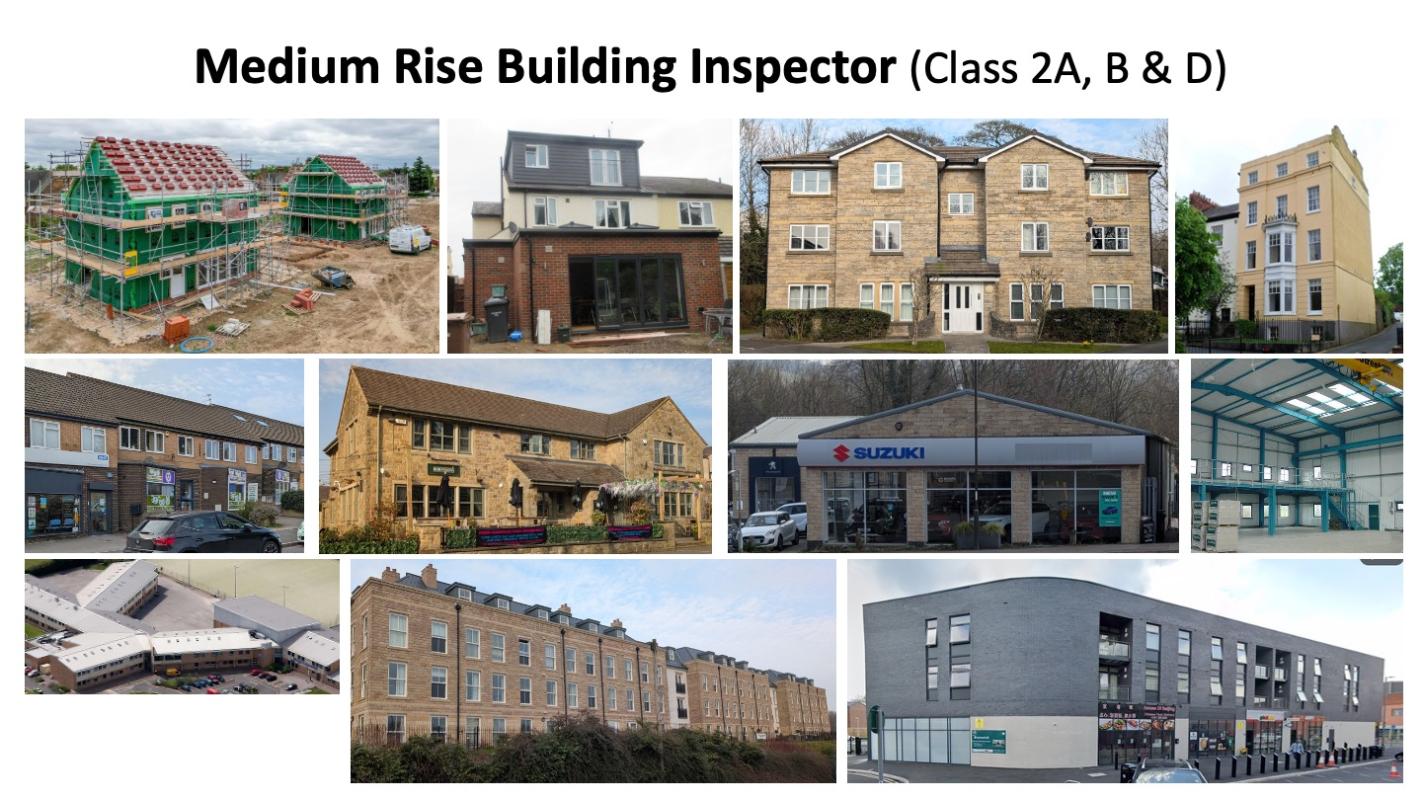
Class 2ABD may be suitable for building inspectors whose current role and evidence extend beyond domestic dwellings but do not yet align with the full Class 2A-F scope.
Applicants for this class will generally be working across a mixture of domestic, low to medium rise residential buildings, including flats, and smaller or less complex non-domestic buildings within the relevant scope.
This class may include work on standard forms of construction, including traditional or well established timber frame systems, where these fall within the relevant scope and can be assessed using established guidance. It may provide a suitable progression route towards Class 2A-F, or a suitable long-term certification scope where the inspector’s role is predominantly centred on this type of work.
GENERAL PRACTICE BUILDING INSPECTOR (CLASS 2A-F)
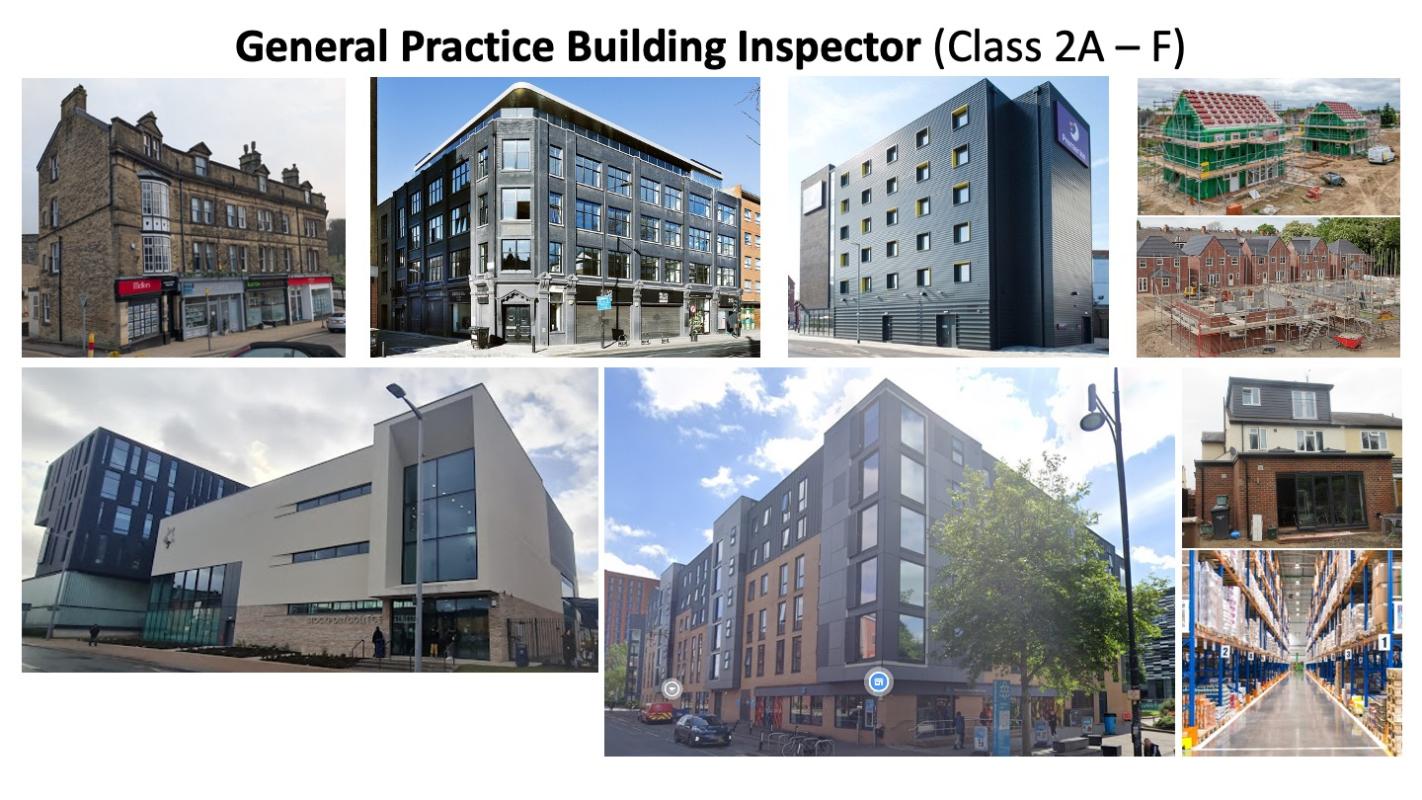
It is anticipated that many building inspectors will seek to achieve and maintain General Practice Building Inspector status at Class 2A-F.
This class is intended for more experienced building inspectors who can demonstrate competence across a wider range of domestic and non-domestic building work within the Class 2A-F scope.
Applicants should be able to apply their knowledge, skills and experience to standard buildings and standard forms of construction, where the relevant statutory guidance, Approved Documents and established technical guidance can be applied. The class does not extend to work outside the inspector’s certified scope, including higher-risk buildings or non-standard construction where specialist competence is required.
SPECIALIST BUILDING INSPECTOR (CLASS 2A-3H)
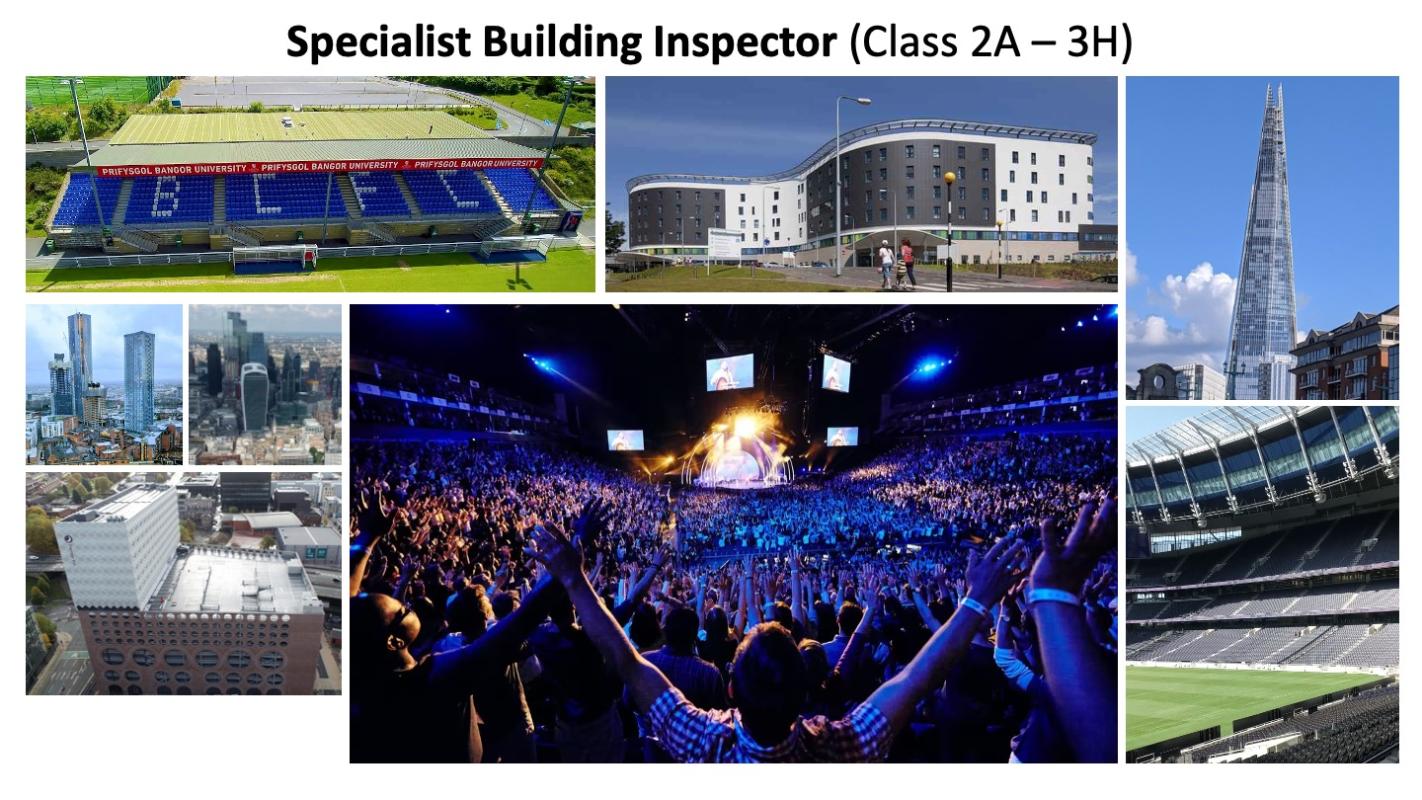
Class 3GH is intended for building inspectors working on higher-risk, complex or specialist building work within the relevant scope.
Applicants for this class should be able to demonstrate a greater depth of competence in fire safety, building safety, complex construction, non-standard forms of construction, higher-risk buildings and the regulatory regime under which this work is controlled.
This class also requires the ability to work effectively with multidisciplinary teams, understand the role of other specialists and apply sound professional judgement when considering complex design, construction and compliance issues.
Zero Tolerance Policy
The BSCF operates to support and assist Building Control Professionals in providing demonstrable evidence of their competence to the Building Safety Regulator. BSCF staff are there to help candidates through the process. However, due to instances of BSCF staff being verbally berated by candidates, whilst BSCF staff have tried to support them with the online platform and approach to written assessments, the BSCF feels it necessary to introduce a ‘zero-tolerance’ policy towards aggressive and/or abusive behaviour.
Such behaviour is considered to be unwarranted, inappropriate, unprofessional and unethical and will not be tolerated. Candidates should apply the same standards of courtesy and dignity to BSCF staff as they would expect to be applied to themselves.
Aggressive or abusive behaviour includes (but is not restricted to) any personal, abusive or threatening comments, bad language, and aggressive gestures. This means that it is not acceptable to be aggressive or direct abuse toward any member of the BSCF staff. Any candidate behaving in such a manner will be removed from the BSCF scheme with immediate effect.
Should you have any problems accessing the portal, please email certification@thebscf.org.
START APPLICATION
If you have any questions regarding validation, please contact the Building Safety Competence Foundation team at certification@thebscf.org.
USEFUL RESOURCES
- BSCF BSI Scheme Information
- BSCF Reasonable Adjustments Policy
- BSCF Access Arrangements and Reasonable Adjustments Guidance
- BSCF Online Assessment Information Pack
- VIDEO: everything you need to know about the competence validation process
- VIDEO (external page) - Registered Building Inspectors Webinar